
 Independent guide · not the operator
DMFirst Games: Game Types Explained
Colour-and-number rounds, crash multipliers, dice and number draws all look different on screen, but they follow a few simple ideas underneath. This guide explains the popular formats, shows how payout odds really work, and lets you try a clearly labelled demo with virtual credits. You must be 21 or older.
About This Page
Updated: 8 Nov 2026This page describes game types in general. DMFirst is an independent guide, so we cannot confirm which titles any operator offers today. The operator’s own lobby shows what is available to you.
Written by the DMFirst Editorial Team · Updated 8 Nov 2026
Table of Contents
Popular Game Formats
Many lobbies are built around fast rounds with simple choices. Here are four formats you will see often, how each one works and what to keep in mind. Names and rules differ between operators, so open the rules inside the game to confirm.
Wingo-style timed rounds
You predict a colour or an exact digit from 0 to 9 in a short timed round, and a new round starts every few minutes. A single digit pays the biggest multiplier, but it wins about one round in ten.
How the odds work →Aviator-style crash games
A multiplier climbs in real time and you cash out before it stops. Large multipliers are rare, and some rounds end almost at once, so fast play can drain a budget quickly.
Set your limits →Trx Wingo-style rounds
The result is taken from a public blockchain hash, so anyone can check where it came from. A public source does not make a result predictable, and it does not remove the house edge.
Randomness explained →K3-style dice games
You wager on the total of three dice (3 to 18), on pairs, or on triples. A specific triple such as 3-3-3 comes up about once in 216 rolls, which is why triple bets pay the largest multipliers.
Read the terms →Multipliers & Payout Odds
Example onlyColour-and-number games usually draw one digit from 0 to 9, and each choice pays a multiplier. The table below shows a common design with the maths worked out. The multipliers are an example, and your operator’s figures and fees may differ, so check the rules in the game.
| Choice | Outcome condition | Example multiplier | Chance per round | Average return per 100 staked |
|---|---|---|---|---|
| Specific number | Exact digit, 0 through 9 | 9.0x | 1 in 10 (10%) | 90.0 |
| Violet | Digit 0 or 5 | 4.5x | 2 in 10 (20%) | 90.0 |
| Green or Red | Green: 1, 3, 7, 9 with 5 as a split. Red: 2, 4, 6, 8 with 0 as a split. | 2.0x on the four main digits; the split digit pays less | 4 in 10 for the full payout | Below 100. Depends on the split payout and any fee. |
| Big or Small | Big: 5 to 9. Small: 0 to 4. | 2.0x | 5 in 10 (50%) | About 100 on paper. A fee or adjusted payout brings it lower. |
How to Start Playing
Take these steps in order. The first three matter most, because they protect you before any money moves.
From account to first round
6 steps- Register on the operator’s verified website or app. Our register guide walks you through it.
- Finish any identity check the operator asks for, so that withdrawals are not delayed later.
- Set a deposit limit and a time reminder before your first deposit. This guide shows how.
- Open the game lobby, pick a game, and read its rules and payout table inside the game.
- Start with the smallest stake and a fixed budget. When the budget is gone, stop for the day.
- Read the withdrawal rules before you deposit: methods, limits and processing times. Treat promises of “instant” payouts with care.
Do Pattern Charts Work?
Many lobbies show a chart of recent results, and some websites teach “patterns” to read from it, such as alternating or repeating runs. It is easy to see why this appeals. The chart looks like information.
In a game with a fair random draw, though, each round is independent. The draw has no memory of the last ten rounds, so a streak says nothing about the next result. A chart shows what already happened, not what will. Anyone selling a pattern system is selling a feeling of control, not an edge.
What a Game Lobby Looks Like
Most apps group games into rows under a few category tabs. The screenshot is the game list in the DmFirst app, and the points on the right tell you what to look at.
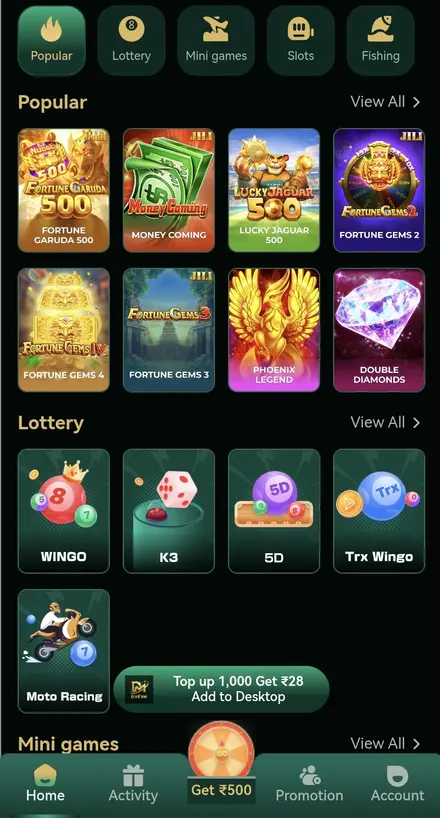
- The tabs at the top (Popular, Lottery, Mini games, Slots, Fishing) filter the list by game family.
- Each row, such as Popular or Lottery, groups games. View All opens the full list for that row.
- Open a game and read its rules before you play. Look for the minimum and maximum stake.
- The menu at the bottom takes you between Home, Activity, Promotion and your Account.
The screenshot is from the operator’s app. Game titles and promotions shown in it belong to the operator and its partners, are not offered by this site and may not be available in your country.
Compare the Families
Here is how results are decided in each family, and the one thing worth checking first.
| Game type | How the result is decided | Pace | Check first |
|---|---|---|---|
| Slots | Random number generator | Fast | Stated return to player and bonus-round rules |
| Table & cards | Cards or RNG, plus your decisions | Medium | Table rules and the house edge |
| Live dealer | Real dealer and equipment | Medium | The operator’s licence and table limits |
| Sports | Outcome of a real event | Varies | Market rules and how bets are settled |
| Fast games | RNG with a multiplier or timer | Very fast | Your own session and time limits |
| Number games | Random draw | Slow to medium | Odds of the draw and the ticket price |
Four Ideas Behind Every Game
If you remember only these four points, you will understand most of what happens at the screen.
Every round is independent
The generator has no memory. A long losing streak does not mean a win is due.
The house edge is built in
Every game keeps a small average share of stakes, so over time players as a group get back less than they stake.
Look for real testing
Licensed operators use independently tested games. Ask who tested them, and do not rely on a badge image.
Your limits do the protecting
You cannot change the odds, but you can decide how much money and time you give a game.
Random Results Demo
Run a few spins, then a thousand. Short runs swing widely. Long runs drift toward the model return, which is why a game can feel generous for an evening and still keep its edge.
Each spin costs 10 virtual credits. Three matching symbols pay 25x and a pair pays 0.5x. Results come from your browser’s random generator. Nothing is stored or connected to any operator.
Press Spin to run one demo round.
Want the idea behind it? Read how RNG and the house edge work.
Play Within Your Limits
21+ only. Gaming costs money, and it is not a way to earn it. Decide how much you can afford to lose before you start, set deposit and time limits, and never try to win back what you have lost. Fast games make this harder, because many rounds pass in a few minutes.
Frequently Asked Questions
What kinds of games are covered here?
Colour-and-number rounds, crash-style multiplier games, blockchain-hash rounds and dice games, plus slots, table games, live dealers and number draws in general. Which of them you can play depends on the operator you use, so check its official platform.
Which payout multiplier is best?
None of them. A higher multiplier simply wins less often. In the example table, a 9.0x choice wins about one round in ten and returns about 90 per 100 staked on average. Check the rules in the game for the real figures.
Can I predict results by reading the chart of past rounds?
No. In a fair random game, each round is independent, so past results do not change the next one. Pattern systems give a feeling of control, not an edge.
Does DMFirst offer every game on this page?
This page describes game types in general. DMFirst is an independent guide, not the operator, so we cannot say which titles are available to you. The operator’s lobby shows what is currently offered.
Are the demo results real?
No. The demo uses virtual credits and your browser’s random generator. It is not connected to any operator, and nothing you see there predicts or reflects a real result.
Can any game guarantee a win?
No. Digital games use a random number generator, so each round is independent, and every game keeps a house edge. Be wary of anyone selling a winning system.
What does return to player (RTP) mean?
It is the share of all stakes a game pays back to players on average over a very long run. A 96% RTP means 4% is kept by the operator. It says nothing about what will happen in one session.
How do I pick a game?
Start with how you want to spend your time and money, not with the biggest prize. Read the rules, find the stated return, and set a deposit and time limit first.
Buod sa Filipino
Random ang resulta ng mga digital na laro, at may house edge ang bawat laro, kaya walang laro na makapagsisiguro ng panalo. Basahin ang mga patakaran at ang stated return bago maglaro, at magtakda ng limitasyon sa deposito at oras. Ang demo sa pahinang ito ay gumagamit lamang ng virtual credits at hindi tunay na resulta.
DMFirst (dmfir.st) is an independent information website. It does not operate games, accept deposits or handle player funds. Rules differ by country; only use operators licensed for your location. Disclaimer · Privacy · Terms